Repository navigation
Improve the default frequency vector: features below 1e-4 rad/s, discrete-time systems, lightly damped resonances and delays - #1086
Merged
Conversation


|
This is an automated message.
|

Codecov Report✅ All modified and coverable lines are covered by tests. Additional details and impacted files@@ Coverage Diff @@
## master #1086 +/- ##
==========================================
+ Coverage 92.17% 92.22% +0.05%
==========================================
Files 42 42
Lines 6119 6146 +27
==========================================
+ Hits 5640 5668 +28
+ Misses 479 478 -1 ☔ View full report in Codecov by Harness. 🚀 New features to boost your workflow:
|


- Remove only the poles and zeros that are located in the origin (at z = 1
  in discrete time) according to the classification of
  `integrator_excess_with_tol`, instead of all features below 1e-4 rad/s.
  The bounds are equivariant under `time_scale`. A cluster counted by
  `count_eigval_multiplicity` is accepted only if its mean is located in the
  origin up to rounding error, so that poles of a high-order system that are
  distributed over several decades are not removed.
- Map the poles and zeros of discrete-time systems to the s-plane by
  s = log(z)/Ts, treat features above the Nyquist frequency as features at
  the Nyquist frequency, and start the grid at least two decades below the
  Nyquist frequency. Previously, log10(|z|) was used as a log-frequency and
  the grid was unsorted and mostly above the Nyquist frequency for large Ts.
- Insert frequencies close to lightly damped pole and zero pairs, spaced
  as ωp(1 ± ζ sinh(u)) for uniformly spaced u, as long as this spacing is
  smaller than that of the logarithmic grid. This resolves resonance peaks
  and the gain and phase crossovers close to them.
- Approximate the frequency response linearly in log(w) in `downsample`,
  since the default frequency vector is no longer logarithmically
  equidistant. The approximation is exact at the segment end points, which
  is required for termination.

Co-Authored-By: Claude Opus 5.5 (1M context) <noreply@anthropic.com>
Claude-Session: https://claude.ai/code/session_01HigNnun4aJKMoWmY7wyULn
…cy vector

Previously, log10(τ) was used as a log-frequency and only delays longer
than 1e4 were considered, which extended the grid upward to approximately
τ rad/s.

Co-Authored-By: Claude Opus 5.5 (1M context) <noreply@anthropic.com>
Claude-Session: https://claude.ai/code/session_01HigNnun4aJKMoWmY7wyULn

baggepinnen
force-pushed
the
default-freq-grid
branch
from
October 9, 2026 06:40
d8791ad to
e317b60
Compare
|
This is an automated message.
|
Co-Authored-By: Claude Opus 5.5 (1M context) <noreply@anthropic.com>
Claude-Session: https://claude.ai/code/session_01HigNnun4aJKMoWmY7wyULn
baggepinnen
marked this pull request as ready for review
October 13, 2026 05:49
baggepinnen
referenced
this pull request
Oct 13, 2026

Co-Authored-By: Claude Opus 5.5 (1M context) <noreply@anthropic.com>
Claude-Session: https://claude.ai/code/session_01HigNnun4aJKMoWmY7wyULn
This file contains hidden or bidirectional Unicode text that may be interpreted or compiled differently than what appears below. To review, open the file in an editor that reveals hidden Unicode characters.
Learn more about bidirectional Unicode characters
Sign up for free
to join this conversation on GitHub.
Already have an account?
Sign in to comment
2 participants


Add this suggestion to a batch that can be applied as a single commit.This suggestion is invalid because no changes were made to the code.Suggestions cannot be applied while the pull request is closed.Suggestions cannot be applied while viewing a subset of changes.Only one suggestion per line can be applied in a batch.Add this suggestion to a batch that can be applied as a single commit.Applying suggestions on deleted lines is not supported.You must change the existing code in this line in order to create a valid suggestion.Outdated suggestions cannot be applied.This suggestion has been applied or marked resolved.Suggestions cannot be applied from pending reviews.Suggestions cannot be applied on multi-line comments.Suggestions cannot be applied while the pull request is queued to merge.Suggestion cannot be applied right now. Please check back later.
Part of #1081.
Problems
All reproducers were checked on top of #1076 (head 1ff5e00), which has since been merged; the branch is rebased on master after the merge of #1076 (f8c5db4).
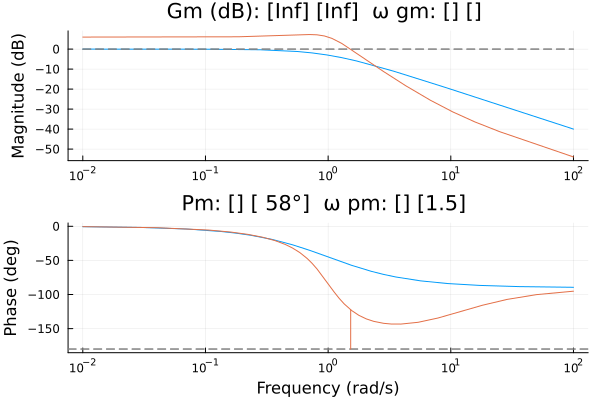
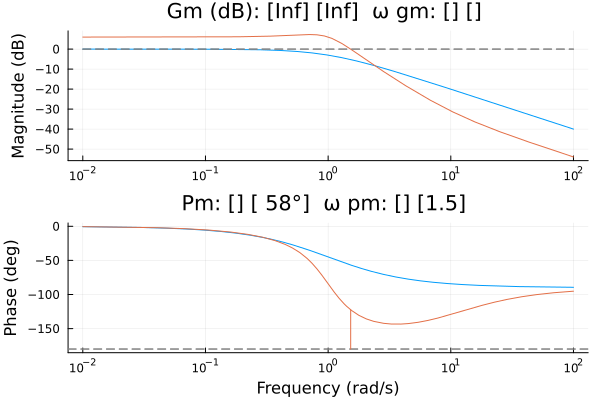
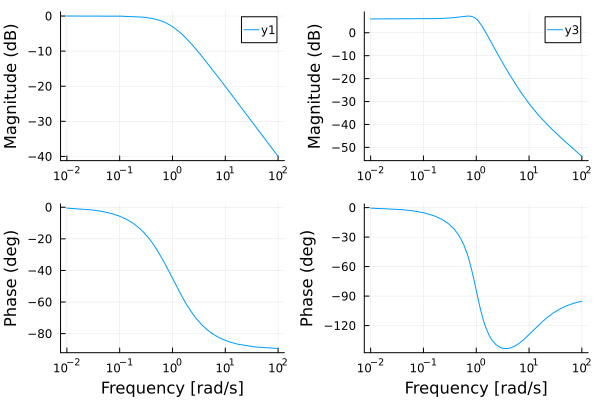
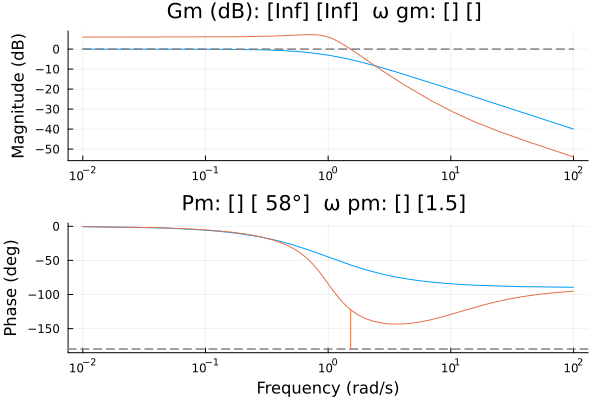
bode,nyquistandsigma. ForG = ss(tf(1,[1,1])),_default_freq_vector(time_scale(G, a), Val(:bode))has the extrema [1, 100] for a = 1e-4, 1e-5, 1e-6, i.e., the grid lies on the high-frequency asymptote. Fortf(1,[1,1])*tf(1e-5,[1,1e-5])the grid starts at 0.01 rad/s, where |G| = 1e-3 although the DC gain is 1.log10(abs(z))of the z-plane roots was used as a log-frequency, and the upper bound log10(π/Ts) was not compared with the lower bound. Forc2d(tf(1,[1,1]), Ts)with Ts = 10, 100, 1000 the grid is unsorted and 99 % of its points lie above the Nyquist frequency. For a pole at 1e-3 rad/s sampled with Ts = 0.01 the grid starts at 0.01 rad/s. Fortf(0.1,[1,-0.9],60)the grid is [0.01, 0.052] although the equivalent pole is located at 1.8e-3 rad/s.tf(1,[1,2ζ,1]), true value vs.bodedefault grid: ζ = 1e-2: 50 vs. 23.5; ζ = 1e-3: 500 vs. 26.4; ζ = 1e-4: 5000 vs. 26.5. Formarginthis results in missed crossovers:L = 0.02*tf(1,[1,2e-3,1])*tf(1,[0.1,1]): no gain crossover is found (pm = Inf) and gm = 1.529, whereas a dense grid gives pm = 168.6° at 0.99005 rad/s, pm = 0.059° at 1.00985 rad/s and gm = 1.0102.marginthrows an error when the system has delay #941 intest_analysis.jl(C*G*H*delay(1)with a resonance at 15.97 rad/s): the default grid misses the phase crossover at 15.9626 rad/s, so the reported smallest gain margin is 28.6 instead of 0.1143 (dense grid)._bounds_and_features(::DelayLtiSystem)used log10(τ) as a log-frequency and only considered τ > 1e4, which extended the grid upward to approximately τ rad/s. For τ = 1e-3 and 1e3 the delay did not affect the grid, for τ = 1e5 the grid extended to 1e6 rad/s.Changes
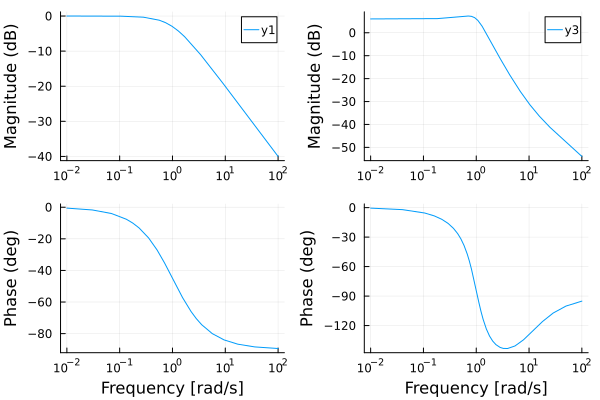
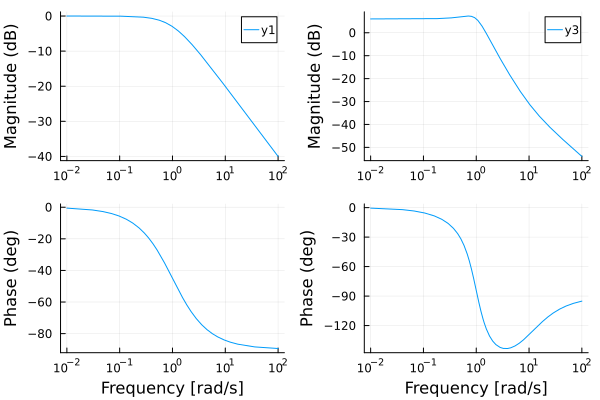
_remove_origin_roots(renamed from_margin_nonintegratorsof Fix default margin frequency ranges and missing phase guides #1076, since it is now used by all plot types) removes only the poles and zeros located in the origin (at z = 1 in discrete time), using the classification ofintegrator_excess_with_tolviacount_eigval_multiplicity. All other features are kept, so the bounds are equivariant undertime_scaleup to the rounding to whole decades. The 1e-4 cutoff is removed for all plot types.count_eigval_multiplicityis(100ϵ)^(1/n)*scale, which approachesscalefor largen. For high-order systems with poles distributed over several decades, it therefore reports a large multiplicity at the origin:count_integratorsof a sum of 30 lightly damped modes with ωn in [0.1, 100] returns 54, andintegrator_excessofprod(tf(1,[1/10.0^k,1]) for k in -4:5)returns 8. With the classification of Fix default margin frequency ranges and missing phase guides #1076 alone, the grid of the first example started at 1 rad/s (Fix default margin frequency ranges and missing phase guides #1076 has the same behaviour for its margin grid)._remove_origin_rootstherefore accepts a cluster only if the mean of its roots is located at the origin up to rounding error: the computed roots of an n-fold root are spread over a radius proportional to ϵ^(1/n), but their mean is perturbed by an amount proportional to ϵ only. For Jordan blocks of size 1 to 5 in 200 random coordinate transformations each, the mean test never rejected a cluster thatcount_eigval_multiplicityhad found (largest ratio of the mean to the tolerance: 0.86 for n = 1, ≤ 2e-3 for n ≥ 2). This change modifies the margin grid of Fix default margin frequency ranges and missing phase guides #1076 only for such systems. The defect ofcount_eigval_multiplicityitself, which also affectsintegrator_excessand therefore the phase adjustment insisomargin, is not changed here.w1 = min(w1, w2 - 1)rule that Fix default margin frequency ranges and missing phase guides #1076 introduced for discrete-time margin grids; the margin-specific extension of Fix default margin frequency ranges and missing phase guides #1076 below the lower bound is unchanged._resonance_frequenciesadds frequencies close to each lightly damped pole or zero pair with natural frequency ωn and damping ratio ζ: ωp(1 ± ζ sinh(u)) for u = 0, 1/8, 2/8, ..., where ωp = ωn sqrt(1 - 2ζ²) is the frequency of the extremum of the magnitude. Close to ωp the spacing is ζωp/8, far from it the frequencies are logarithmically spaced with ratio approximately exp(1/8). Frequencies are added only as long as this spacing is smaller than that of the logarithmic grid, so no frequencies are added for well-damped pairs (the grid oftf(1,[1,1,1])is unchanged). For an undamped pair, ωp itself is omitted, so the response is not evaluated at a pole. For ζ = 1e-3 this adds approximately 100 frequencies per pair, for 30 such modes (60 pole and zero pairs) the grid has 6497 frequencies. The returned vector is sorted and unique but not logarithmically equidistant.downsampleapproximated the data linearly in the index, which is equivalent to linear approximation in log(w) only for logarithmically equidistant grids. It now approximates linearly in log(t) when all t are positive and in the index otherwise (Nyquist curves, where the index is a common parameter of the real and imaginary parts and log(w) is equivalent for logarithmically spaced grids). The linear approximation is written as a convex combination, so that it equals the data at the segment end points without rounding error; otherwise the loop does not terminate when the rounding error exceeds the tolerance (this occurred intest_pid_design.jl). The resonance frequencies are added after the grid extension of Fix default margin frequency ranges and missing phase guides #1076, which computes a logarithmic step from the uniform Bode grid._findCrossings/interpolateinsisomargin,unwrapandstabregionPIDdo not assume uniform spacing._bounds_and_features(::DelayLtiSystem)adds a real feature at -1/τ for each delay τ > 0 and recomputes the bounds with the same rules as for poles and zeros.bode,nyquistandsigmadescribe the default frequency vector.Results after the change
time_scale(G, a), a = 1e-4 / 1e-5 / 1e-6c2d(tf(1,[1,1]), Ts), Ts = 10 / 100 / 1000tf(0.1,[1,-0.9],60)LaboveThe phase margin 0.049° of
Ldiffers by 0.01° from the dense-grid value 0.059°, since the gain crossover is interpolated linearly; the phase margin is the difference of two terms of approximately 5.7°.Effect on existing users
bode(sys),nyquist(sys)andsigma(sys)return a frequency vector that is not logarithmically equidistant if the system has lightly damped poles or zeros.marginwithout a frequency vector finds crossovers close to resonances that were previously missed (see themarginthrows an error when the system has delay #941 example, whose reported smallest gain margin changes from 28.6 to 0.114).downsample(internal, used by the plot recipes) approximates the data linearly in log(t) for positive t.Tests
test_freqresp.jl: equivariance undertime_scale(a = 1e-6, 1e-4, 1e3) for all plot types, slow poles, integrators, classification of poles distributed over several decades, discrete-time grids for Ts from 1e-3 to 1000 (sorted, unique, ending at π/Ts, containing the equivalent pole frequency), roots at z = 0 and z = 1, resonance peaks and anti-resonances within 1 % for ζ = 1e-2, 1e-3, 1e-4 and ωn = 1e-3, 1, 1e3, a discrete-time resonance, an undamped resonance, and an unchanged grid for a well-damped system.test_analysis.jl: the margin exampleLabove; themarginthrows an error when the system has delay #941 test assertedimag(L(iω)) ≈ 0with the absolute tolerance 1e-6 at the gain-margin frequency. The smallest gain margin is now located at the resonance, where |L| = 8.7, and the crossover is interpolated, so the tolerance is made relative (1e-3|L|) and the gain margin and its frequency are compared with dense-grid reference values.test_delayed_systems.jl: grid bounds for delays 1e-3, 1e3, 1e5.test_plots.jl:downsampleretains the resonance peak of a non-equidistant grid and terminates with zero tolerance.Results with Julia 1.12.7 on Linux:
test_freqresp.jl: 415/415 passed. The allocation test at line 69 passes both with this PR and on the head of Fix default margin frequency ranges and missing phase guides #1076 (102/102), so the allocation-limit failure reported in Fix default margin frequency ranges and missing phase guides #1076 (Julia 1.10 on Windows) does not occur in this environment.test_analysis.jl: 248/248 passed.test_delayed_systems.jl: 147/147 passed.test_hammerstein_wiener.jl: 70/70 passed.test_pid_design.jl: 152/152 passed.test_discrete.jl: 60/60 passed.test_plots.jl: 34/34 passed.test_makie_plots.jl: 103/103 passed.The full package test suite was not run.
Host:
demeter6, Claude Code sessionsession_01HigNnun4aJKMoWmY7wyULn, working directory~/.julia/dev/ControlSystems/.claude/worktrees/agent-ad0f8fa7703ba359e🤖 Generated with Claude Code
https://claude.ai/code/session_01HigNnun4aJKMoWmY7wyULn