
| Download | Paper | Developer Slack | Community Discord | Community WeChat |

TurboQuant (
tq4) 4-Bit KV Cache Compression:
- True 4-bit nibble-packed KV cache storage (0.5 B/elem, 4.00× memory savings vs
fp16).- Orthogonal Walsh-Hadamard Transform (WHT) + 16-level Lloyd-Max optimal scalar quantizer with custom CUDA JIT store/dequant kernels (
quant_store.cu/quant_dequant.cu).- Bit-matched reconstruction with MAE < 0.006 vs torch reference oracle.
- Enabled via
--kv-quant tq4.Multi-Shard GGUF, Qwen3 / Qwen3.5 / Qwen3.6 Families, & Every GGML Quant Type:
- Supports reading multi-shard GGUF checkpoints (
split-00001-of-000NN) across directories or direct shard paths.- Adds
qwen3moe,qwen35moe, andqwen35dense architectures.- Support for all 21 GGML quant types (including standard, K-quants, and I-quants).
RTX 4060 Laptop, 8GB VRAM, 64GB system RAM, routed experts offloaded to host memory.
Model Arch Quant Result Ornith-1.5-35B-A3B qwen35moe IQ3_S 8/8 factual, 47 to 50 tok/s Ornith-1.5-35B-A3B qwen35moe IQ3_XXS 6/6 factual, 50 to 52 tok/s Ornith-1.5-35B-A3B split into 3 shards qwen35moe IQ3_S 6/6 factual, 44 to 46 tok/s Qwen3-30B-A3B qwen3moe IQ4_XS 6/6 factual, 45 to 47 tok/s A 35B model with 3B active, in 16GB, decoding at 50 tok/s on a laptop GPU with 8GB of VRAM. For reference, llama.cpp on the same file on CPU does 11 tok/s.
These carry a
general.architecturethis fork now handles. I have not run all of them, so this is "the loader covers it", not "I benchmarked it". Bank column is from reading each file's tensor table.
Model Arch Expert banks Notes Qwen3-235B-A22B qwen3moe check per quant split, 3 to 10 shards Qwen3.5-122B-A10B qwen35moe uniform at IQ3_S should load as is Qwen3.6-35B-A3B qwen35moe mixed at IQ3_S needs a --purequantOrnith-1.0-35B-AEON qwen35moe mixed at Q4_K_M needs a --purequantQwen3.8-27B qwen35 dense none Q4_K_M, test in progress Qwen3.6-27B qwen35 dense none Q4_K_M Qwen3.5-27B qwen35 dense none Q4_K_M Qwen3.5-9B qwen35 dense none Q4_K_M Qwen3.5-4B qwen35 dense none Q4_K_M Dense models have no expert banks, so the uniform-bank rule below does not apply to them and ordinary
_Mquants are fine.More of my quants at huggingface.co/vcruz305.
All 21 ggml types are now described on the Python side.
csrc/gguf/already dispatched 19 of them, but the tables only listed 6, so K-quants and I-quants were unreachable for every architecture rather than just this one.
Family Types Prefill Decode Standard Q4_0, Q4_1, Q5_0, Q5_1, Q8_0 MMQ MMVQ K-quants Q2_K, Q3_K, Q4_K, Q5_K, Q6_K MMQ MMVQ I-quants IQ1_S, IQ1_M, IQ2_XXS, IQ2_XS, IQ2_S, IQ3_XXS, IQ3_S, IQ4_NL, IQ4_XS dequant plus matmul MMVQ I-quants have no MMQ kernel upstream, so prefill falls back to
ggml_dequantizeand a torch matmul. That branch already existed but was unreachable, because_MMQwas tested before_DEQUANTand the two sets were identical.
- Fixed a silent data corruption bug. None of the five
switch (type)blocks ingguf_kernel.cuhad adefault:, and the output tensor is allocated withtorch::empty, so an unsupported quant type returned uninitialized memory instead of raising.ggml_moe_get_block_sizereturned 0. That one is worth having on its own, independent of the rest of this fork.- Documented the four transforms llama.cpp's converter applies that a loader has to undo:
ssm_aholdsArather thanA_log, the(1+w)norm shift is already folded in, V heads are stored tiled rather than grouped when there are fewer K heads than V heads, and merged projections are not uniformly typed. None of these are visible to shape, dtype or byte identity checks. The model loads, runs at full speed, and produces fluent nonsense.- Tests derive the block sizes from
ggml-common.hand extract thecaselabels fromgguf_kernel.cuat runtime, so the Python tables cannot drift from the kernels without a test failing.
- MoE expert banks have to use one ggml type across every layer. The GPU slot pool is a single allocation and
moe_vec.cuhindexes it asexpert * nrows * (ncols / qk)with no padding allowance, so two row strides in one pool would read every block at the wrong offset. llama.cpp's_Mand_XXSlevels raise the precision of the first few layers'ffn_down_exps, which trips this. Those refuse to load with an error naming the layers. Quantize withllama-quantize --pureto get one type throughout. Dense models are unaffected.- TP=1 only, same as the existing Gemma-4 GGUF path.
- The NextN/MTP block is dropped, so no speculative decoding.
- Expert bank loading is serial, so first load of a 16GB checkpoint takes about a minute. Converting to FTW with
ft checkpointavoids paying it every time.- Tested with the flashinfer attention backend. The triton fallback is unexercised here.
- First token argmax matches llama.cpp CPU on 2 of 6 single token prompts. Every disagreement is a plausible near tie, and this runs CUDA W4A8 MMVQ against CPU AVX, so I do not think exact agreement is reachable. Stating the number rather than implying it is bit exact.
Unlock datacenter-class intelligence on the hardware you already own — Run 290B+ frontier MoE models locally on your gaming PC at blistering interactive speeds.
FreeToken is an edge-native Mixture-of-Experts (MoE) serving engine designed for running frontier-scale open-weight models on personal and consumer hardware. It treats heterogeneous edge resources—GPUs, CPUs, host memory, and interconnects—as a unified, elastic inference platform. Its core features include:
-
Fast Edge-Native Runtime: Provides efficient MoE serving with bandwidth-adaptive CPU–GPU co-execution (
$q^\star$ policy), full-layer double-buffered prefill streaming, global LRU expert caching, graph-compatible execution, and the FTW fast weight format. - Semantic-Aware Caching: Features semantic anchor checkpoints for recurrent state and KV caches, allowing agentic context edits (e.g., tool calls, thinking blocks) to avoid redundant context recomputation.
- Elastic Memory Management: Supports dynamic, runtime VRAM re-allocation between expert caches and KV memory without engine restarts or weight reloading.
- Broad MoE & Ecosystem Support: Supports frontier open-weight MoE models (e.g., DeepSeek-V4-Flash, Qwen3.6-35B-A3B, GLM-5.2) across various parameter scales and quantization formats (e.g., MXFP4, NVFP4, FP8, BF16), with Anthropic/OpenAI-compatible APIs for seamless integration with real-world coding and tool-calling agents (e.g., Codex, Claude Code, OpenCode, OpenClaw, DeepSeek Harness).
- Diverse Consumer Hardware: Scales across consumer laptops, gaming desktops, and workstation GPUs, with native support for NVIDIA RTX 30, RTX 40, and RTX 50 series GPUs.
Download FreeToken for Windows or Linux at flashml.ai. It sets the engine up for you and gives you a GUI for running models, chatting, and tuning the engine.
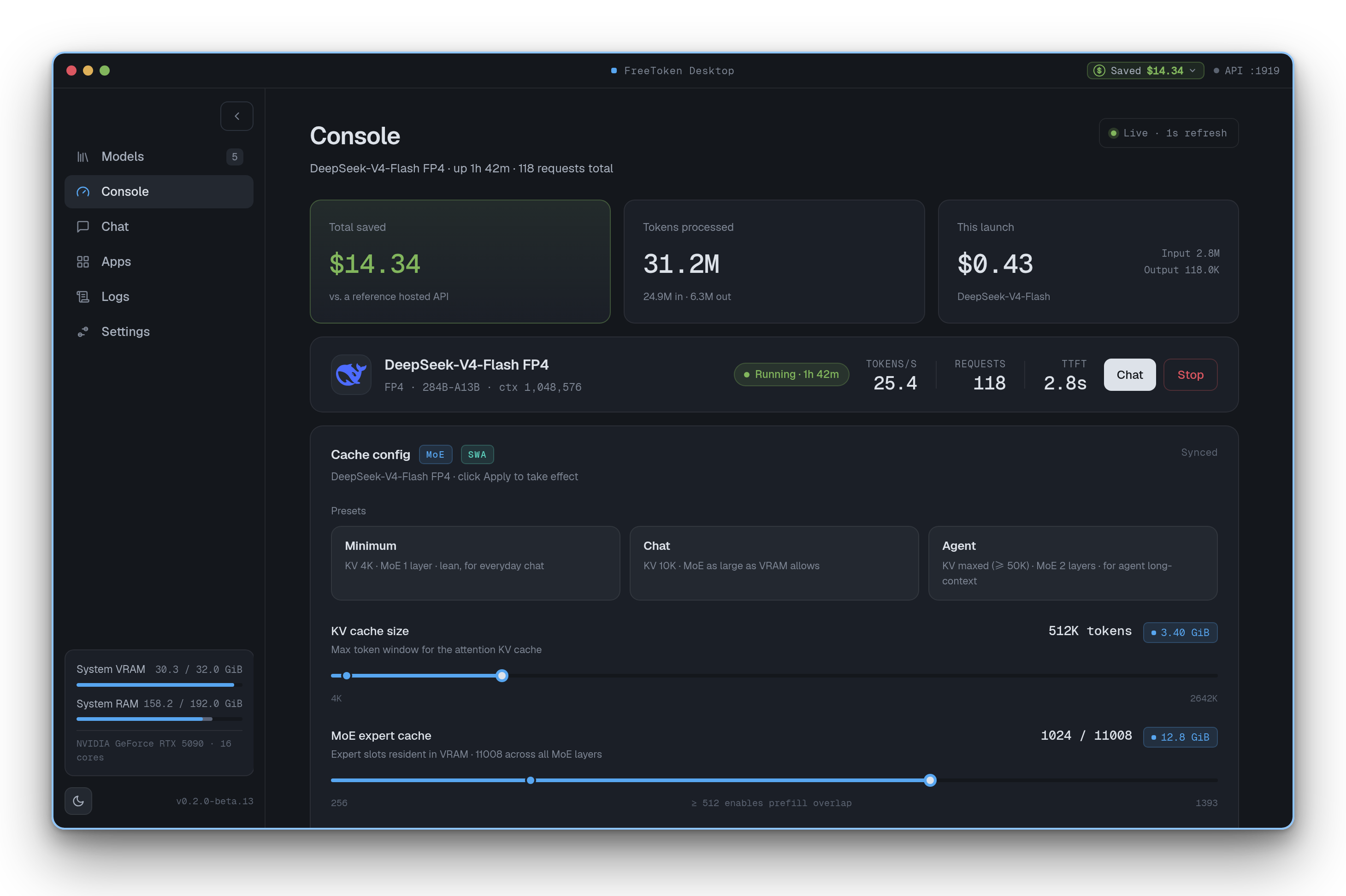
Install FreeToken with uv (recommended) or pip:
uv pip install "freetoken[accel]"Or build from source:
git clone https://github.com/FlashML-org/FreeToken.git && cd FreeToken
uv venv && source .venv/bin/activate
uv pip install -e ".[accel]"
For More details:
If you use FreeToken for your research, please cite our paper:
@article{yang2026freetoken,
  title={FreeToken: Efficient Edge-Native MoE Serving with Bandwidth-Adaptive Execution},
  author={Yang, Shuo and Fan, Xiaoze and Pan, Melissa and Xi, Haocheng and Wang, Zhe and Sun, Shanlin and Keutzer, Kurt and Han, Song and Zaharia, Matei and Xu, Chenfeng and Stoica, Ion},
  journal={arXiv preprint arXiv:2608.16157},
  year={2026}
}FreeToken was deeply inspired by mini-sglang, and learned the design and reused code from the following projects: SGLang, vLLM, FlashInfer, flash-linear-attention, LightLLM and llama.cpp.